
7 keys to successful recruiting!
Human resources professionals, are you tired of making mistakes in your hiring processes? Discover our 7 tips for successful recruitment!
 1 minute

Work is becoming increasingly complex. We are being asked to know how to do everything, how to adapt, how to code, how to market and how to communicate. Against this backdrop, recruiters need more than ever to assess candidates' potential, measure their ability to succeed in a changing environment and solve complex problems. Cognitive tests, based on the evaluation of cognitive functions (logic, memory, reasoning, etc.) can provide recruiters with invaluable data to help them select the candidates best suited to their needs.
Cognitive tests date back more than a century. One of the pioneers in this field was French psychologist Alfred Binet, who developed the first intelligence tests to assess children's intellectual abilities. This early work led to the creation of a variety of cognitive tests, aimed at measuring specific functions such as memory, attention, perception and reasoning.
Defined as tools for measuring specific mental abilities, cognitive tests can include verbal, numerical or spatial assessments. In recruitment, these tests are used to predict a candidate's ability to adapt, solve problems and process complex information quickly. Their ability to provide an objective assessment makes them an essential asset for HR in their selection processes.
Cognitive tests are among the most reliable predictors of future job performance, outperforming many other assessment tools. Research consistently shows their strong predictive validity, with correlation coefficients ranging from 0.50 to 0.51 - though more recent meta-analyses, such as Sackett et al. (2022), suggest a slightly lower estimate of 0.31. This means that cognitive skills have a high and direct link with success in a given job, particularly in terms of the ability to adapt to new tasks and solve complex problems. This level of accuracy is superior to many other assessment methods, such as structured interviews or personality tests.
By using these tests and combining them with recruitment interviews, recruiters can better identify candidates with the potential to evolve and adapt to dynamic work environments.
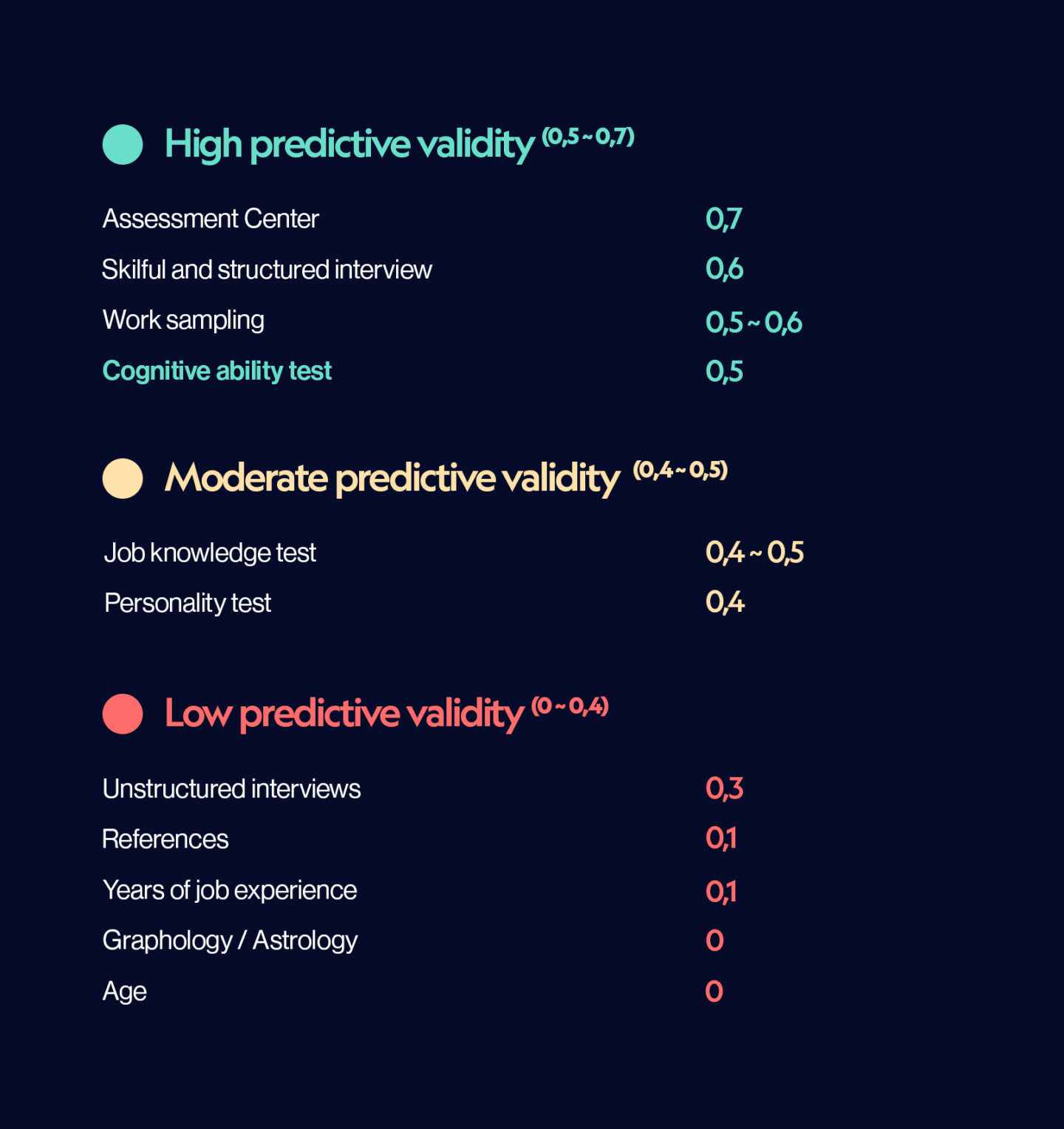
Integrating a cognitive assessment into a recruitment process has a number of significant advantages for human resources professionals:
Although cognitive tests are extremely powerful, they also have certain limitations that recruiters should bear in mind:
This list is intended to help you compare the different cognitive tests available. Although it is not exhaustive, it is essential to remember that these tests are not always directly comparable because of the diversity of the items they assess.
For example, it makes no sense to compare a test that measures only verbal reasoning with one that assesses numerical reasoning. What counts above all is choosing the test that is best suited to your specific needs and professional context.
A cognitive-behavioural approach to assessing a candidate's cognitive resources and behavioural skills.
A test with gamified cognitive exercises to assess memory, attention, problem-solving, critical thinking and other key cognitive functions.
The Criteria Cognitive Aptitude Test measures your ability to solve problems, use new information and think critically.
A fun assessment of cognitive skills that measures problem-solving, critical thinking and numerical reasoning.
A non-verbal assessment test that evaluates overall cognitive performance through logical and deductive reasoning.
A test that sheds light on general, verbal, numerical and abstract reasoning skills.
To assess candidates' intellectual and learning potential.

Cognitive tests offer HR professionals an effective and scientifically validated method of predicting job performance and identifying high-potential talent. Although they cannot provide a complete picture of the candidate, they are a powerful tool when used in conjunction with other assessment methods. By maximising the use of cognitive tests and taking into account their limitations, recruiters can make more informed decisions and optimise the success of their future employees.
Human resources professionals, are you tired of making mistakes in your hiring processes? Discover our 7 tips for successful recruitment!
1 minute

Explore the most predictive evaluation methods in recruitment, scientifically validated, in this practical and innovative guide.
 1 minute
Newsletter
Thank you for subscribing to our newsletter!
You’ll now receive our articles, be informed of our events and benefit from our white papers.
Complete the form to get a demo with one of our experts
Footer form
Thank you!
Your info was submitted successfully.
Attention
Please rotate your device