Why use cognitive tests in recruitment?
Discover why cognitive assessments are essential in recruitment: they enable performance prediction, provide objective evaluation, and help identify top talent.
 2 minutes
Ah, personality tests! A dirty word to some purists, but a term widely used in the professional world to refer to behavioural assessments during recruitment or talent development. These psychometric tools have become essential for companies seeking to better understand their employees and maximise performance.
But what is really behind this term? What are the most reliable and widely used personality tests on the market? In this article, we'll explore the best (or not) professional personality tests available, detailing their specifics, their benefits and how they can help companies make informed decisions.
Get ready to discover a complete panorama of the tools shaping the modern world of work.
Professional personality tests are psychometric tools designed to assess the character traits, behaviours, preferences and motivations of individuals in a professional context. They provide a better understanding of how a person might behave in different work situations.
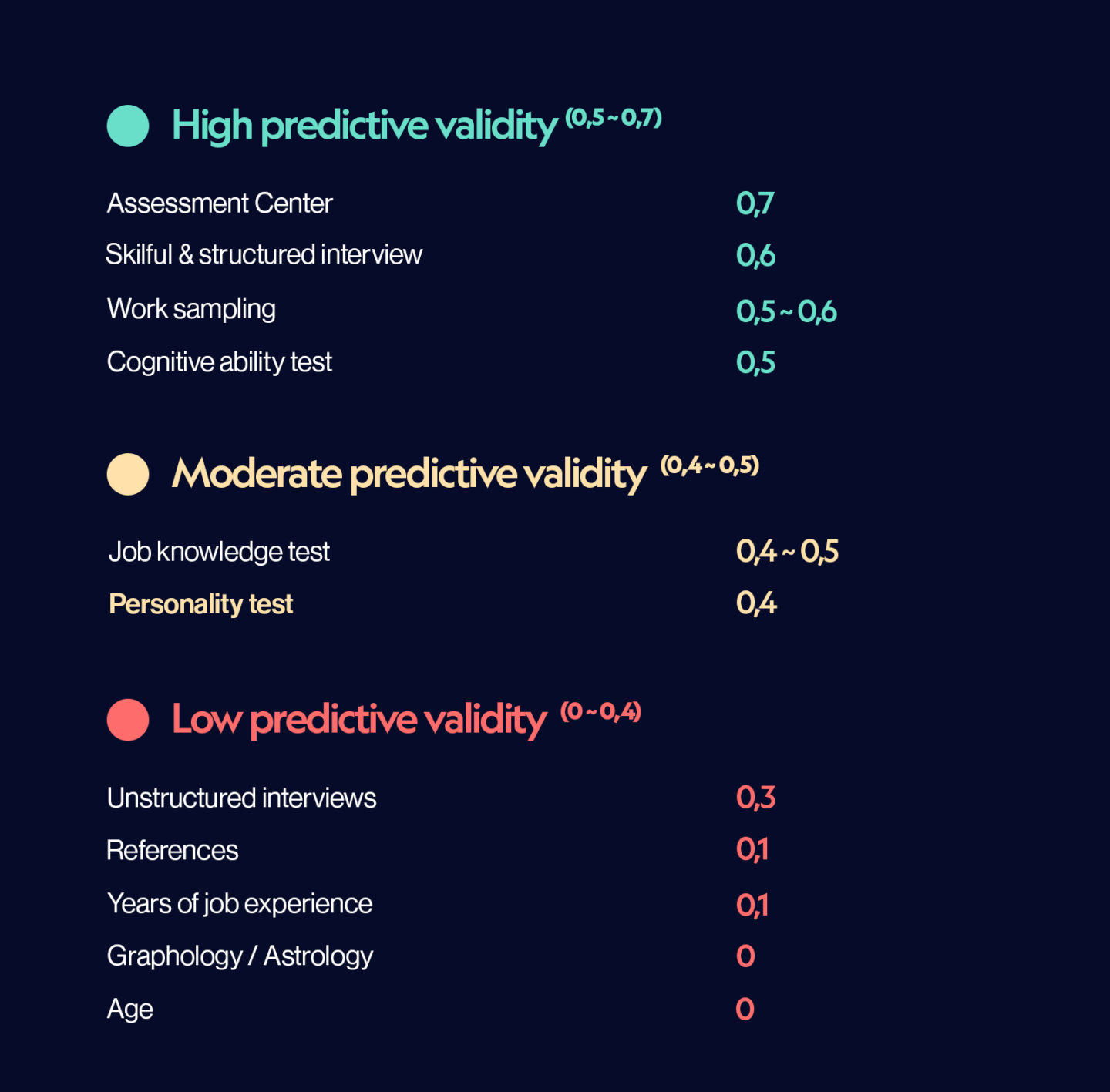
These tests have significant predictive power (0.4), because they can anticipate individual behaviours that explain performance at work: from adaptability to company culture and interactions between colleagues.
Studies have shown that certain personality traits are correlated with indicators of professional success, such as productivity, job satisfaction and leadership potential.
However, it is important to note that the scientific literature does not support the direct predictive value of personality tests. They cannot directly predict success, but they can effectively predict individual behaviours that will potentially explain future performance.
Personality tests have evolved considerably since their inception. Initially based on fundamental psychological theories, they have been refined and validated by decades of research. Today, modern tests incorporate advances in neuroscience and behavioural psychology, offering more accurate and reliable tools.
In addition to basic scientific models such as the MBTI and the Big Five, personality tests now include new measures such as motivations, strengths of character and psychological contract. These additions make it possible to refine assessments and offer more reliable, contextualised results.
New innovations include the use of AI to analyse results and provide personalised recommendations.
When benchmarking a personality test, whether for individual or professional purposes, there are a few things to look out for:
This list has not been created in any particular order (well, in alphabetical order). Tests can only be compared according to the specific needs of the user and the company. Some tests will allow you to be flexible and quick, while others will offer a deeper analysis of the human singularity and complexity of a person. All these tests, however, will help you make a more informed decision.
This test is based on both Carl Jung's theory of personality types (MBTI), combined with the Big Five model of personality traits. It identifies 16 distinct types, each based on preferences for extroversion/introversion, logical/intuitive reasoning, rational/emotional decision-making and structured/spontaneous organisation
Central Test's BF5 test is based on the Big Five personality model, a widely recognised and scientifically validated approach. The test assesses five main dimensions: openness to experience, conscientiousness, extraversion, agreeableness and neuroticism. Each dimension is measured through specific behaviours and attitudes, providing a comprehensive overview of personality.
The Everything DiSC DISC test (Wiley) assesses four main dimensions: Dominance, Influence, Stability and Compliance. This model helps to understand the behavioural preferences of individuals in a professional context, making it easier to anticipate their communication style and interactions.
AssessFirst's Drive test measures an individual's deep-seated motivations in a professional context. It focuses on what drives each person to make a commitment and excel. Drive identifies the key motivators, such as the search for challenges, autonomy or the need for recognition, to assess the match between the candidate's profile and the company.
The Echo professional personality test is distinguished by its multidimensional approach, combining the Big Five models and McClelland's needs theory to offer an in-depth assessment of personality, motivations and relationships at work. By going beyond simple behavioural analysis, this test explores key aspects of performance at work, such as commitment, adaptability and influence. Scientifically validated, it provides a detailed understanding of talents and areas for development, while offering more precise indicators for predicting professional success.
A tool without a mind to guide it is blind, but a mind without a high-performance tool is ineffective...

CEO, PerformanSe
The Hogan Personality Inventory (HPI), developed by Hogan Assessments, evaluates personality in a professional context by focusing on the positive traits that contribute to workplace performance. This assessment is designed to identify qualities that influence success in organizations, such as sociability, initiative, and emotional stability. The HPI centers on personal characteristics that support a productive and collaborative work environment.
The High Potential Trait Indicator (HPTI), developed by Thomas International, is designed to assess an individual’s personality traits to determine their suitability for high-potential roles. Based on six key dimensions—conscientiousness, emotional adjustment, curiosity, risk approach, ambiguity acceptance, and competitiveness—the HPTI helps identify both individual strengths and areas for development.
More than just a personality test, Idonéo is an assessment tool designed to measure the alignment between an individual’s behavioral competencies and the specific requirements of a given role. It evaluates key performance drivers such as adaptability, priority management, and decision-making, helping identify candidates who are not only likely to thrive in their roles but also contribute actively to collective success. Idonéo assesses both the individual’s potential and their ability to proactively support organizational goals.
The SHL Motivation Questionnaire (MQ) is grounded in a theoretical framework that integrates several motivational psychology models. This tool is designed to identify what drives an individual to perform at their best, while also uncovering the work environments that enhance both productivity and well-being. It explores various motivation domains such as recognition, autonomy, challenge, and teamwork.
Personality tests should be used to inform, not dictate, hiring decisions. As one component of a comprehensive recruitment strategy, they offer valuable insights but should always be combined with other evaluation methods.

PhD, Head of R&D Programs, PerformanSe
The PAPI (Personality and Preference Inventory), developed by Talogy, is a personality assessment tool designed to explore an individual’s motives and behaviors in the workplace. It helps organizations understand how a person is likely to respond to various work situations, particularly in areas such as initiative-taking, collaboration, and stress management.
PAPI provides insight into the behavioral preferences that influence an individual’s performance and adaptability within an organizational environment.
The Sosie 2nd Generation, developed by TalentLens, is a personality and values inventory designed to assess an individual’s motivations, behavioral style, and preferences in a professional setting. Unlike traditional personality tests, the Sosie uniquely combines personality traits with personal values, providing a more holistic view of the factors that drive engagement, motivation, and fit with organizational expectations.
We agree, the list is long. But beyond simply describing models or theories, you now have a comprehensive overview of the psychometric landscape and the leading experts in personality science.
We don’t just say this because it’s our area of expertise, but because it’s the truth: professional personality assessments have become essential tools in today’s workplace. By helping recruiters and managers better understand the strengths, weaknesses, and motivational drivers of individuals, these tools support more informed and strategic decision-making.
Choosing the “right” test will depend on the specific needs of your organization and the relevance of the underlying theoretical model. In any case, personality assessments are powerful allies when it comes to anticipating performance and unlocking human potential.
That said, it's critical to use these tools ethically, in accordance with the standards and principles of psychometrics. Without a solid ethical framework, the predictive validity of these assessments can be seriously undermined. Misinterpreting results—or relying on them without truly understanding the underlying items, scales, or algorithms—is akin to reading the stars for guidance: risky and unreliable.
In any case, we hope this guide helps you find the assessment that best fits your goals. And remember: PerformanSe's tools are the best ;)
Newsletter
Thank you for subscribing to our newsletter!
You’ll now receive our articles, be informed of our events and benefit from our white papers.
Complete the form to get a demo with one of our experts
Footer form
Thank you!
Your info was submitted successfully.
Attention
Please rotate your device